Design systems thinking delivered to your inbox
Insights on scalable UX, design governance, performance-first web design, and PSEO systems — no noise, no trends
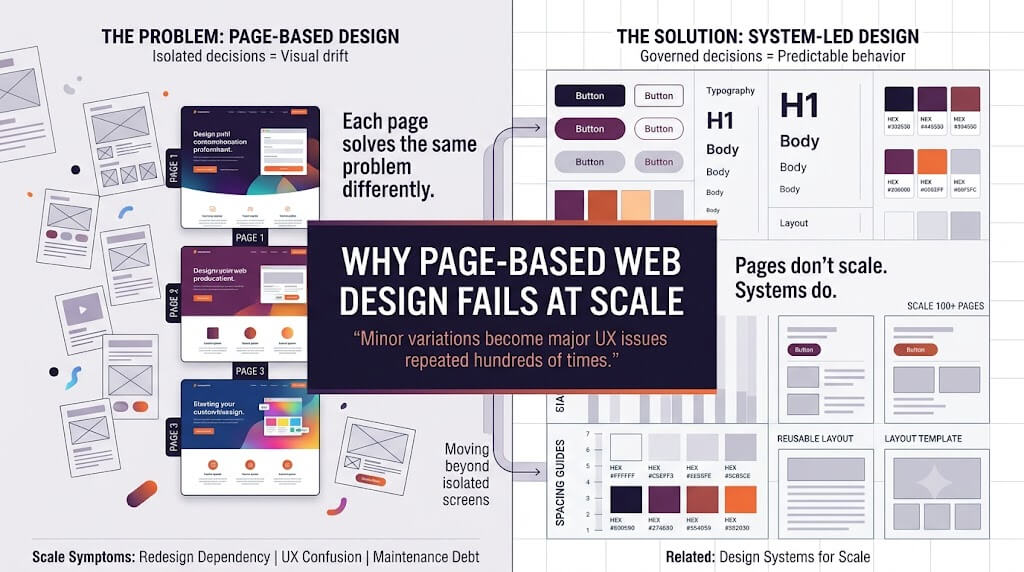
Page-based web design assumes that each page can be designed independently without affecting the rest of the website. This assumption holds only at a small scale. Once content expands, contributors increase, and templates multiply, page-based decisions accumulate into structural inconsistency that design quality alone cannot fix.
Pages don’t scale. Systems do.
Page-based design focuses on how a page looks in isolation. It prioritizes visual completeness over systemic behavior. This creates designs that photograph well but fail when repeated, modified, or extended across large content sets.
This approach breaks because:
At scale, isolated decisions stop being isolated.
What feels like a minor variation on one page becomes a major UX issue when repeated hundreds of times. Spacing changes, hierarchy shifts, and layout exceptions compound until the website loses visual rhythm and predictability.
Common scale symptoms include:
These are not design flaws. They are system failures.
When websites are built page by page, the only way to fix accumulated inconsistency is redesign. Redesigns become frequent, expensive, and disruptive because no governing system exists to stabilize growth.
This leads to:
Systems reduce redesign dependency by allowing controlled evolution.
Content-heavy websites expose the weakness of page-based thinking faster than any other type. Long-form content, structured data, and programmatic pages demand consistency in hierarchy and layout behavior.
Page-based design struggles because:
Systems absorb content growth. Pages resist it.
Design systems remove the need to redesign every page. Instead, they define how layouts behave, how components repeat, and how hierarchy remains stable regardless of content variation.
System-led design provides:
This shifts design from creativity-driven to reliability-driven.
Page-based design does not fail immediately. Early success creates false confidence because problems surface only after scale is reached. By then, reversing the damage requires structural intervention, not visual fixes.
Early indicators are often ignored:
By the time symptoms are obvious, scale has already locked them in.
Choosing page-based design is not a stylistic choice. It is a strategic risk decision. It assumes the website will not grow significantly or that future redesigns will absorb the damage.
System-led design assumes growth and prepares for it.
If your website is growing and design feels harder to maintain each month, the issue is rarely execution quality. It is almost always page-based thinking at scale.
Explore Web Design Systems → Design Systems for Scale
What is page-based web design?
Page-based web design focuses on creating each page individually, without using reusable components or standardized templates. Each page is treated as a separate entity, often leading to inconsistent layouts and fragmented user experience as the website grows.
Why does page-based design fail when websites grow?
It fails because each page requires custom decisions, which multiply as new pages are added. This creates design debt, inconsistent UX, slower performance, and maintenance challenges across a content-heavy or PSEO-driven website.
How does page-based design affect scalability?
Page-based design limits scalability by forcing repeated manual work for every new page. Without standardized components or governance, large sites quickly become unmanageable and visually inconsistent.
Can page-based websites maintain UX consistency?
Maintaining UX consistency is extremely difficult in page-based design. Each page is prone to unique decisions, making navigation, interaction patterns, and visual hierarchy unpredictable as content grows.
What is the alternative to page-based design?
The alternative is a system-led, component-based design approach, where reusable templates, governance rules, and UX systems ensure consistency, scalability, and predictable performance across all pages.