Design systems thinking delivered to your inbox
Insights on scalable UX, design governance, performance-first web design, and PSEO systems — no noise, no trends
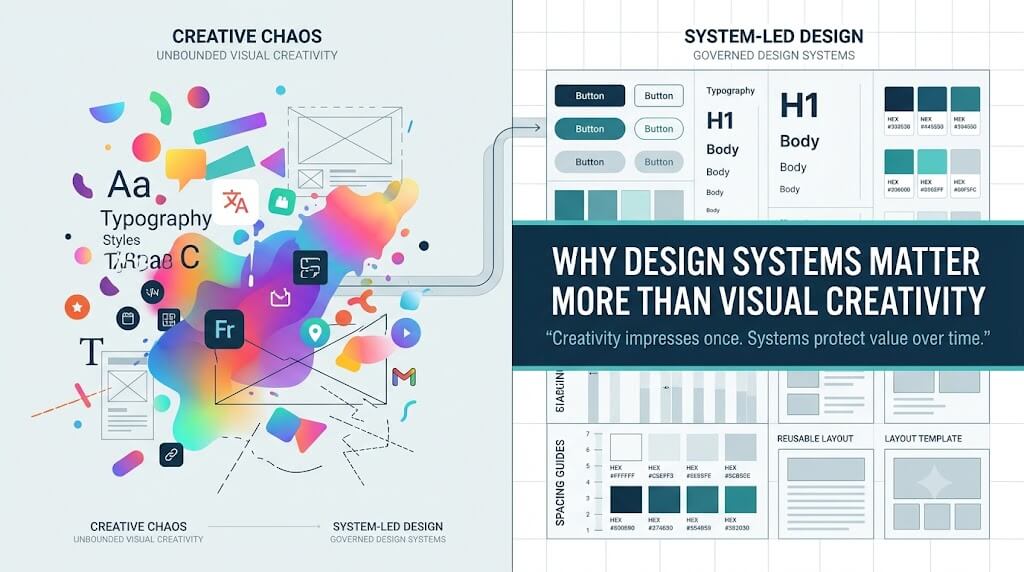
Why Design Systems Matter More Than Visual Creativity, Visual creativity is often mistaken for design maturity. A visually strong website can still be structurally weak if it lacks systems. I have seen highly creative designs collapse under growth because creativity was allowed to replace governance, consistency, and long-term thinking.
Creativity impresses once. Systems protect value over time.
Creative design decisions usually solve what is visible today. They optimize for impact, differentiation, and aesthetics within a limited scope. What they rarely solve is how the design behaves when content doubles, templates multiply, or new teams contribute.
This limitation appears when:
Creativity without systems scales effort, not stability.
At scale, freedom without boundaries creates fragmentation. Each creative decision introduces variation, and variation multiplies across pages. Over time, the website loses visual rhythm and UX predictability, even if each page looks individually polished.
Unbounded creativity leads to:
Systems exist to limit damage, not limit expression.
Design systems do not remove creativity. They relocate it. Instead of redesigning layouts repeatedly, creativity is applied within components, hierarchy, and controlled variation. This produces consistency without monotony.
System-led creativity focuses on:
This creates mature design, not decorative design.
Websites built on visual creativity often depend on redesigns to fix accumulated inconsistency. Redesign becomes the reset button for structural mistakes that systems would have prevented.
Redesign dependency usually indicates:
Systems reduce redesign frequency by absorbing change safely.
As websites grow, contributors change. New designers, developers, and content teams interpret design differently. Systems protect UX by removing interpretation from critical decisions.
Design systems ensure:
This protection matters more than visual novelty.
Visual trends age quickly. Systems age slowly. A website built on trends requires frequent updates to stay relevant, while a system-led website can evolve incrementally without losing clarity or trust.
Long-term relevance depends on:
Systems outlive aesthetics.
Experienced designers know when not to add. Design maturity shows in restraint, hierarchy, and clarity, not in visual density. Systems enforce this restraint consistently, even under growth pressure.
Mature design prioritizes:
This is where design becomes strategic.
If your website relies on visual creativity to stay coherent, scale will eventually expose its limits. Systems provide the structure creativity alone cannot sustain.
Explore Web Design Systems → Design Systems for Scale
What is a design system in web design?
A design system is a structured framework of reusable components, layout rules, typography, and UX principles that ensure consistency, scalability, and performance across an entire website, beyond just visual styling.
Why are design systems more important than visual creativity?
Design systems prioritize stability, scalability, and predictable user experience over one-time visual experiments. While creativity matters, system-led design ensures websites remain functional, consistent, and maintainable at scale.
How do design systems support large-scale websites?
For large websites or PSEO-driven platforms, design systems provide repeatable templates, consistent components, and governed layouts that reduce maintenance overhead and prevent UX decay as the site grows.
Can creativity exist within a design system?
Yes. A design system provides boundaries and rules, allowing creative expression within components and templates. This ensures innovation does not compromise usability, performance, or consistency across the site.
What happens when websites rely only on visual creativity?
Without systems, visual creativity can lead to fragmented layouts, inconsistent user experiences, maintenance challenges, and performance issues, especially as content, templates, and pages expand.